
Call for Papers: International Conference on Transformative Inclusive Education 2026
Inclusive Education Nepal invites scholars, researchers, practitioners, educators, and policymakers to submit papers for the International Conference on Transformative Inclusive Education, to be held in Kathmandu, Nepal, on December 1 and 2, 2026.
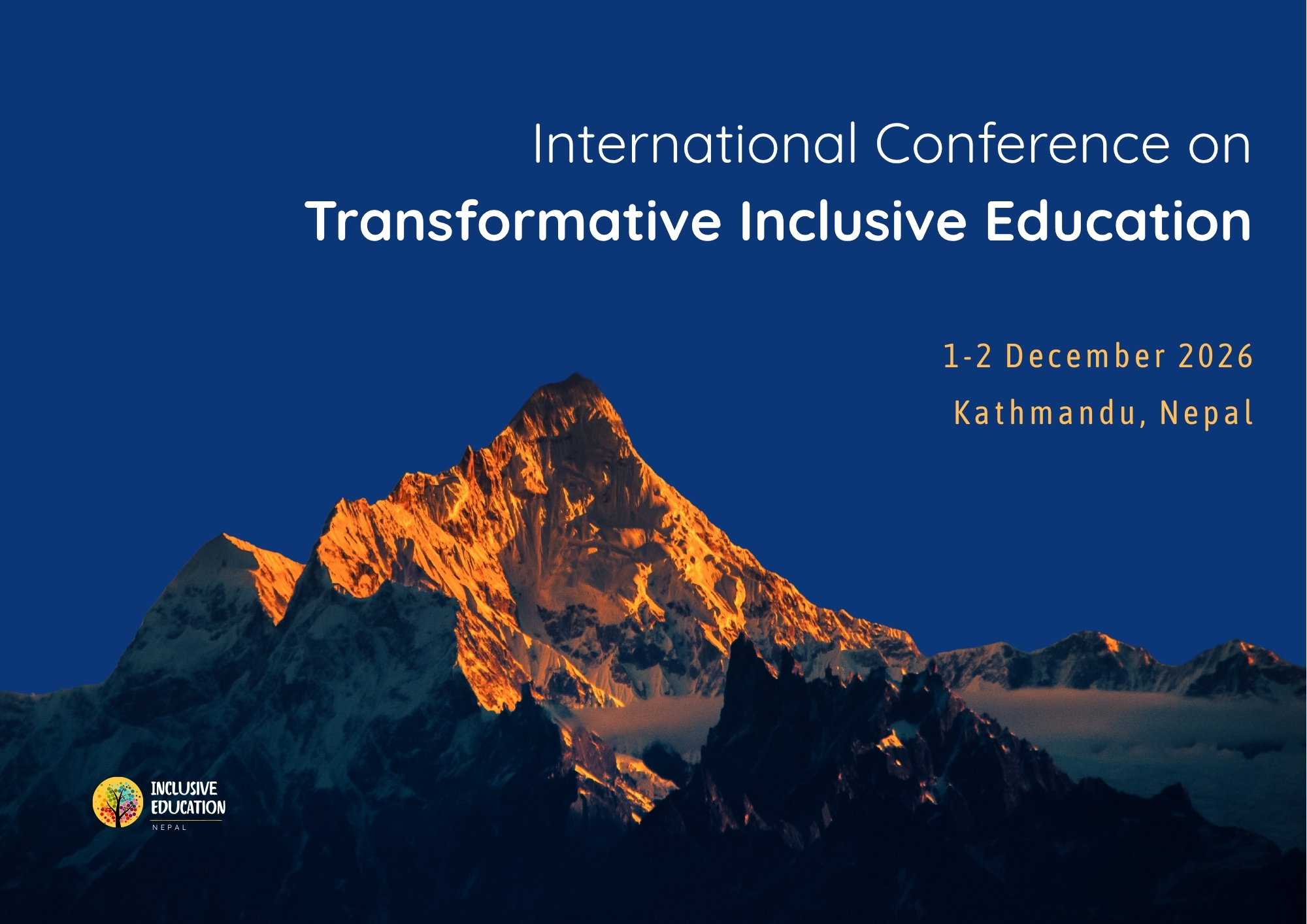
Inclusive Education Nepal invites scholars, researchers, practitioners, educators, and policymakers to submit papers for the International Conference on Transformative Inclusive Education, to be held in Kathmandu, Nepal, on December 1 and 2, 2026. The theme of this year is: Rethinking Pedagogy: From Accommodation to Transformation.
This conference proceeds from a conviction that has guided IEN’s work since its founding: inclusive education is not an accommodation strategy. It is a systemic transformation of pedagogy, of learning environments, of power relations, and of the assumptions embedded in how we define quality education. The question facing education systems today is not whether inclusion should happen. It is whether teaching and learning are designed to make it happen consistently, equitably, and at scale.
The global evidence is unambiguous: the dominant model of inclusion has not worked. Across the world, 250 million children are in school but failing to acquire foundational literacy and numeracy. Children with disabilities remain significantly less likely than their peers to develop basic literacy and numeracy skills. The out-of-school population has now risen for a seventh consecutive year, reaching 273 million in 2024, meaning one in six children, adolescents, and youth worldwide are excluded from education. SDG 4 is not merely off track: at current rates of expansion, the world would achieve only 95% upper-secondary completion by 2105. Progress on legal frameworks has been measurable but insufficient. The share of countries with inclusive education laws has risen from 1% to 24% since 2000, and those whose laws specifically call for children with disabilities to be taught in inclusive settings have increased from 17% to 29% (UNESCO, 2026). Yet the structural commitment remains shallow: fewer than 1 in 10 countries have a sufficiently strong equity focus in their education financing, and over one in six children now live in conflict-affected areas, representing millions of additional learners out of school beyond what official statistics capture. Three decades after the Salamanca Statement committed the world to education for all, the gap between declaration and classroom reality remains vast
The reason is not a shortage of commitment. It is a fundamental flaw in how inclusion has been conceived and implemented. For decades, the prevailing approach has treated inclusive education as a matter of placement: moving learners with disabilities or from marginalized communities into existing classrooms while leaving curricula, pedagogies, and assessment systems unchanged. CRPD General Comment No. 4 (2016) explicitly names this as integration, not inclusion, and calls for something categorically different: the transformation of educational culture, policy, and practice so that every learner is genuinely seen, supported, and able to contribute. What is needed is not better accommodation within systems designed to exclude. What is needed is the redesign of those systems from the ground up.
Transformative pedagogy is the hinge on which this redesign turns. Frameworks such as Universal Design for Learning (UDL), Culturally Sustaining Pedagogy, and Disability Studies in Education converge on a shared insight: when learning environments are designed for the full range of human diversity from the outset, rather than retrofitted for individual difference, the outcomes improve for every learner, not only those who have historically been excluded. This is not an idealistic claim. It is an evidence-based argument with implications for how teachers are prepared, how curricula are built, how schools are led, and how education systems are governed.
Nepal’s experience makes this global argument concrete. The country holds one of the strongest legal and policy frameworks for inclusive education in South Asia, with constitutional guarantees, the Act Relating to Rights of Persons with Disabilities (2017), and the School Education Sector Plan (2022–2032) all affirming the right to inclusive, quality education. Yet a persistent gap separates policy from classroom practice. Teachers are expected to implement inclusion without adequate preparation. Children with disabilities remain unidentified or underserved. Officially, 2.2% of Nepal’s population has a disability, against global estimates of 5–10%, pointing to deep under-identification. Curricula built for a narrow range of learners continue to disadvantage the majority. This conference takes Nepal’s context seriously: not as a problem to be solved by importing external models, but as a generative site for producing knowledge that can advance the global field.
We particularly welcome contributions that center the lived experiences of persons with disabilities and other marginalized learners, challenge deficit-based frameworks, interrogate the conditions under which transformative pedagogy can take root, and bridge the distance between research and practice.
Conference details
| Abstract Submission Opens | June 1, 2026 |
| Abstract Submission Deadline | September 1, 2026 |
| Notification of Acceptance | September 15, 2026 |
| Conference Dates | December 1-2, 2026 |
| Conference Venue | Kathmandu, Nepal |
Conference theme
The conference is organized into the main theme of Rethinking Pedagogy: From Accommodation to Transformation
Conventional approaches to inclusion have often meant placing students with disabilities or from marginalized groups into existing classrooms while leaving teaching methods unchanged. Transformative pedagogy inverts this logic: the system is redesigned to respond to the full range of human diversity from the outset. This theme invites contributions examining the following areas:
- Shifting from deficit-based to asset-based approaches to learner diversity
- What does “quality education” mean when it includes all learners?
- Teacher beliefs, identities, and their role in enabling or constraining inclusion
- Universal Design for Learning (UDL) as a framework for equity and justice
- Disability Critical Race Theory (DisCrit) and intersectional frameworks in education
- Caste, disability, and marginalization in South Asian education systems
- Gender, disability, and compounded barriers to learning
- Geographic inequity: rural-urban disparities in inclusive education provision
- Culturally sustaining and culturally revitalizing pedagogies
- Mother tongue-based multilingual education and inclusive practice
- Community-centered and Indigenous approaches to education for all
- Decolonizing curriculum and assessment in pluralistic societies
- Building evidence bases for inclusive education in low-resource contexts
- System-level coordination: mapping actors, aligning mandates
Submission types
| Research Paper | Empirical, theoretical, or mixed-methods research on any conference theme. Abstracts of 300–350 words; full paper (optional) of 4,000–6,000 words. |
| Practice Paper | Documentation and critical reflection on inclusive education interventions, school-based innovations, or program implementations, particularly in Nepal or South Asia. Abstracts of 300–350 words. |
| Lived Experience Paper | Contributions from persons with disabilities and other marginalized community members reflecting on experiences of inclusion and exclusion in education. These may be co-authored with researchers. Alternative formats (oral presentation, video, or visual presentation) are welcome. Abstracts of 200–300 words. |
| Panel Proposal | A coordinated session of 3–4 papers addressing a shared question or theme, with a designated chair. Panel proposals should include a 200-word overview and individual abstracts of 250 words per paper. |
We are looking for work that
- Challenges the assumption that inclusive education means placing diverse learners into unchanged systems
- Draws on evidence (empirical, practitioner, or experiential ) rather than assertion alone
- Engages honestly with failure, complexity, and the gap between policy and practice
- Centers the voices and perspectives of those most affected by exclusion
- Points toward what is possible, not only what is broken
- Is accessible to a mixed audience of researchers, practitioners, and policymakers
Abstract submission email
Please submit your abstracts to: office@inclusiveeducationnepal.org.
For any queries, please also feel free to reach out to us through the same email or contact us at: +9771 4500063.
Accessibility and Participation
IEN is committed to making this conference fully accessible. The following provisions will be in place:
- Sign language interpretation (Nepali Sign Language and International Sign)
- Accessible venue with wheelchair access throughout
- All conference materials available in accessible digital formats
- Remote participation options for presenters and attendees who cannot travel
- Reasonable accommodation support available on request
About Inclusive Education Nepal
Inclusive Education Nepal is a Nepal-based organization working toward system-wide transformation of inclusive education in Nepal, spanning policy, practice, infrastructure, and public understanding. It treats inclusive education not as a standalone intervention but as a national ecosystem requiring coordinated action across government, civil society, schools, and communities.
IEN’s work includes building the National Inclusive Education Network; developing the National Directory of Inclusive and Special Education Services; delivering school-level safeguarding and child protection training; producing knowledge resources in Nepali and English; and centering the lived experiences of persons with disabilities in all its activities. This conference is an extension of that mission: creating a space where global scholarship meets Nepali practice, and where the encounter transforms both.
| Inclusive Education Nepal Gahanapokhari, Kathmandu, Nepal | Tel: +977 14500063 | Email: office@inclusiveeducationnepal.org inclusiveeducationnepal.org |
Found this event helpful?
Share it with others who might benefit from this information.